REGISTER NOW: Uncomfortable Conversations: The Skills Crisis
REGISTER: 8THIRTYFOUR Skills Survival School Founding Cohort

A tale of woe – Nasty Gal

Share This Post:

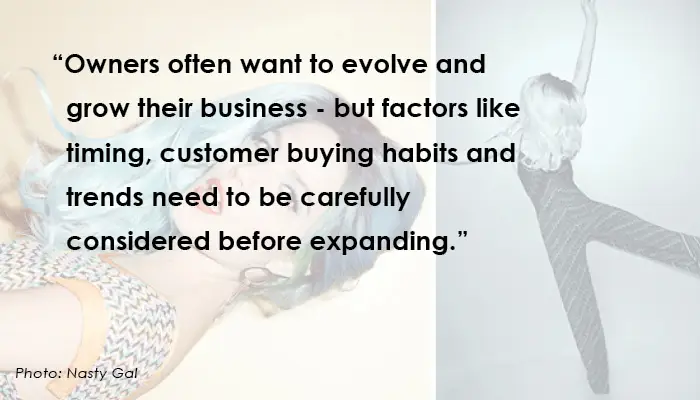
A photo by Nasty Gal features black text reading, "Owners often want to evolve and grow their business - but factors like timing, customer buying habits, and trends need to be carefully considered before expanding."

Too often, a company’s story serves as a cautionary tale for other business owners. This is the case for the popular women’s brand Nasty Gal.  This past November the company filed for bankruptcy after bursting onto the scene in 2006 as an eBay based business that used MySpace as their main marketing tool.
The company found it’s niche by reselling vintage clothing and jewelry to those seeking the ‘gritty cool girl’ style, based on founder, Sophia Amoruso’s own taste.
So where did they go wrong?

  • The Nasty Gal brand was synonymous with Amoruso, with her personality and style launching the brand into the national spotlight where growth soon became explosive. Amoruso remained in the role of CEO until 2015. Entrepreneurs often struggle to function in the CEO role and get tangled up in the day to day minutia that takes them away from the big picture thinking, where they are best utilized. With Amoruso at the helm, the company had several lawsuits filed against them and a host of other management issues, according to The New York Times.
  • The brand also grew very quickly and needed more investment capital, to keep up with demand. This included the addition of several brick and mortar stores to support online efforts. Knowing your customer base and their buying patterns is key to any business’ success. With the addition of the retail stores, operating costs skyrocketed and in-store sales never took off.  A reminder that sometimes a company’s core business model is truly the best.  Owners often want to evolve and grow their business- but factors like timing, customer buying habits and trends need to be carefully considered before expanding.
  • Culture also became a growing issue at Nasty Gal, with constant turnover and several workplace lawsuits being filed. Culture will make or break a company, yet most businesses refuse to make it a focus and leave it to chance.

When a company grows and grows and grows it becomes increasingly hard to stay true to your brand and roots. Growth should be intentional and should be dictated by your customers. It is so important that owners entrepreneurs and business owners understand their strengths and play to them.
Sources: New York Times, Forbes

Responses

Your email address will not be published. Required fields are marked *

Search

Recent Posts

Something on Your Mind?

If you ever need proof that personal brand matters...Kim got to see the @nasaartemis II launch in person as a direct result of her Big Deal Energyâ„¢. 

You need to work hard, show up authentically, and provide value. That was her message to a room full of students and young professionals at @western_michigan_pmi's theProject Collegiate Competition. 

The Big Deal Energyâ„¢ Workshop is on June 23. Register at the link in bio.
Employers think Gen Z is lazy, entitled, and will quit the second things get hard. That perception is keeping you out of the room before you ever get a chance to prove otherwise.

The good news is, you can flip the script, but it will take some serious work and a personal brand, or as Kim Bode refers to it: Big Deal Energyâ„¢.

Kim is speaking at theProjectâ„¢ Collegiate Event, hosted by the Project Management Institute Western Michigan Chapter on April 14. She'll cover how to build a personal brand that actually sounds like you (not ChatGPT) and how you can show your value through social, content and networking. 

Link in bio to learn more.
No one talks about how lonely it is to own a business. The tough decisions land on you, the business doesn't pause when you need a break, and nobody - not your employees or your spouse - really gets it. 

If you know a business owner, tell them they're doing a good job. It matters more than you know.
The growth stage is the hardest part of building a business. 

Kim was recently quoted in @corpmagazine on what she sees running the Women's Entrepreneurial Fellowship: women who have built something, survived the hardest part, and are still doing everything themselves. The natural tendency to be humble and attached to their work creates unique business challenges for women; they put up walls because they can't be vulnerable. 

Meanwhile, when a woman CEO needs growth capital, she compiles three years of tax returns before a bank will schedule a meeting, while her male competitor closes the same deal over drinks.

When women have access to the right resources, they grow and invest back. Full article at the link in bio.