View the updated 2019 version of Marketing vs Advertising vs Public Relations.
At 834 | Integrated Communications, clients rely on our ability to provide a full range of communications services. Do you need an ad placement in a magazine? We can hook you up. Having trouble marketing your product to a specific audience? 834 has a few tips and tricks that can help get your messaging in order. Oh, you need to gain some media coverage or find out the best ways to get involved in the community? We are your ladies (and guy).
There is a reason we are good at what we do. Want to know what it is? Of course you do. It is because we know the difference between the core services we provide; marketing, public relations (PR) and advertising. As similar as those three institutions might seem, there are distinct differences between each.
Let us break it down by definition before we fully nerd out on you and provide you with way more information than you would ever want to know
Marketing: “The activity, set of institutions, and processes of creating, communicating, delivering and exchanging offerings that have value for for customers, clients, partners, and society at large” (ama.org).
Advertising: “The structured and composed non-personal communication that is usually paid for and usually persuasive in nature, about products (goods, services and ideas) by identified sponsors through various media,” (M: Advertising 2nd Edition 2014).
Public Relations: “A strategic communication process that builds mutually beneficial relationship between organizations and their publics,” (PRSA.org).
Got it yet? If not, it is fine…that is all kind of boring, so we get it! Luckily we can help break it down for you a little more. There are a couple key phrases that will help make the differences pretty clear.
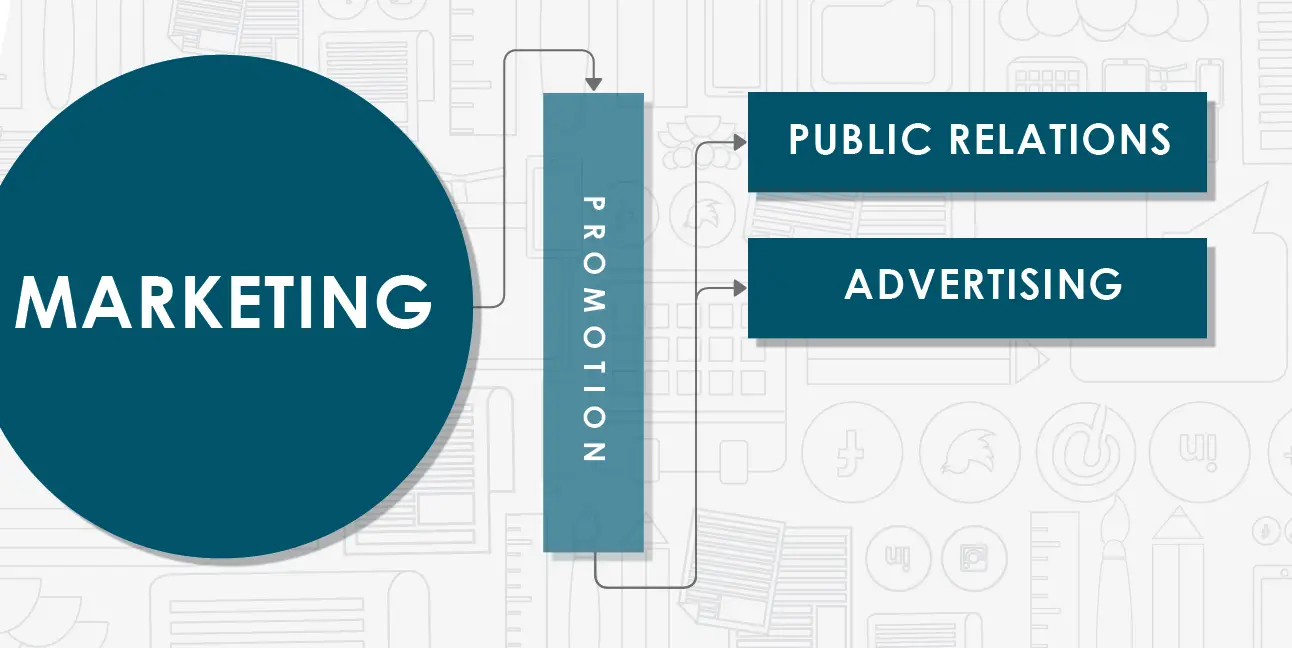
Marketing (Set of institutions – creating – communicating – delivering – society at large): Marketing adds an additional component to the process by focusing on a product or service from its inception to its purchase. Marketing is more all encompassing, not just one specific practice. It is built on four P’s: product, price, place, and promotion. The main goal of marketing is to promote and distribute a product or service to a customer. Wait a minute! Isn’t that what the goal of Ad and PR are also? Yes, and no. Advertising and PR exist under marketing, but only under the promotions “P.” Marketing puts emphasis on how the product actually gets into the consumer’s home, which is not the case with advertising and PR, at least not to the extent of marketing. Advertising and PR also have very little to do with product development or where it will be sold. There is certainly overlap, but each practice requires a specific set of skills and knowledge to get it right. Marketing is more big-picture based while advertising and PR are more focused.
Advertising (non-personal – paid – persuasive): The practice of advertising is based on trying to persuade you to buy a product with out actually meeting face-to-face. When you see an ad on TV or you don’t have a salesman sitting next to you on the couch drinking wine and munching on pizza rolls, right? The advertisement alone is meant to get you hooked to buy. In addition, the majority of the ads you see day-to-day are paid for, which is a major difference when compared to PR.
Public Relations (strategic communication – mutually beneficial – publics): In PR the main goal is to create (you guessed it) relationships. Think about the complexity of any given relationship in your life (best friend, sibling, parent, etc.), that is what PR is all about. The time and work it takes to build and maintain a relationship is what sets PR apart from the other two institutions. The relationships built in PR need to be beneficial to both the organization and the public (investors, customers, partner businesses, employees, etc.). You don’t go to help grandma fix her TV and expect that good cookies won’t be involved. Same goes for organizations and their publics. It is all about finding connections that help make things better for all parties involved.
When you combine advertising, PR and marketing into one great big pile of strategic communications awesomeness, you get integrated marketing communications. That is when things get really fun. Well at least we think so, but we will save that for another blog. Until then study up…or even better just give us a call and leave it to the pros.