
REGISTER NOW: Uncomfortable Conversations: The Skills Crisis
REGISTER: 8THIRTYFOUR Skills Survival School Founding Cohort

Who Does Google Think You Are?

Share This Post:

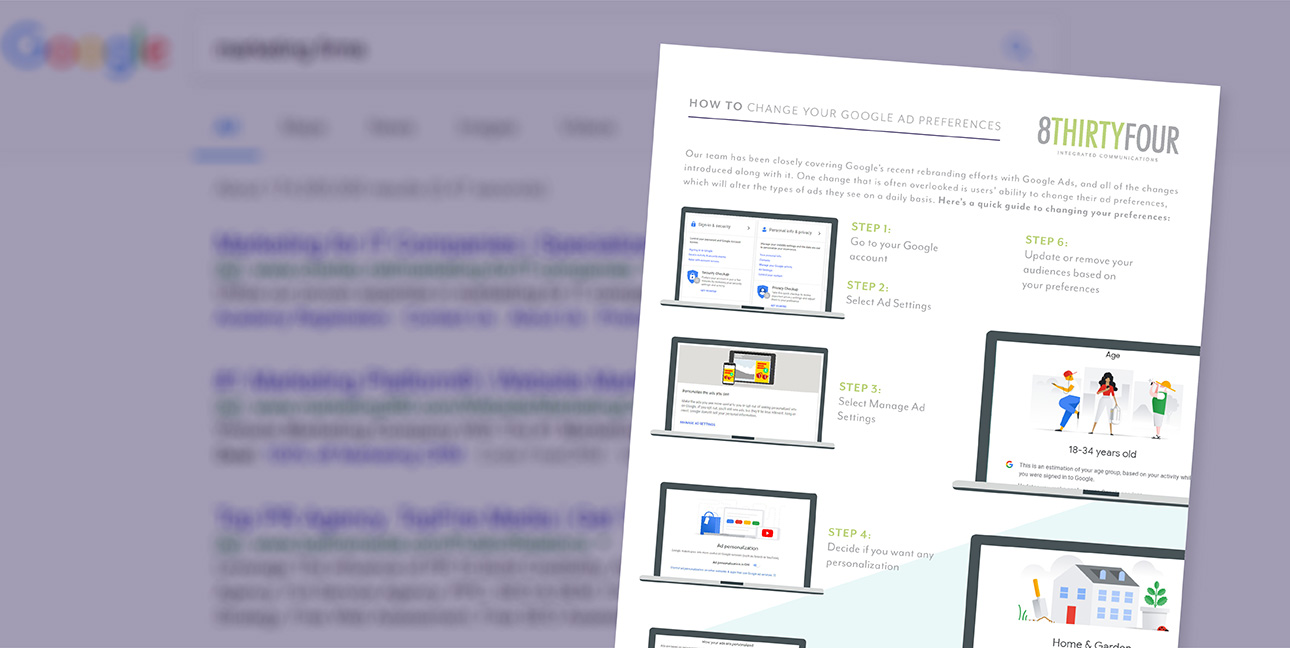
A page of Google search results with a PDF about ad settings superimposed over it

We’ve been covering Google’s rebranding efforts with Google Ads this summer, and all of the changes they’ve introduced along with it.
Today’s insight from our team is BIG: you can now change what types of ads you see as a user.
Our advice is to get ready to chuckle when you see what content Google currently thinks you’re interested in seeing.
For the most part they do a pretty good job, but as our team reviewed their accounts, there were a couple audiences that were a little off. For example, Google was adamant that we wanted more parenting ads when none of us have children. Or, they insisted that our least athletic team member is interested in football equipment.
We’re going to analyze why this change is so important in this blog, but if you want to skip to the good part, and check out your info for yourself:
Watch our video – Learn With 8THIRTYFOUR: Google Ad Preferences

Download our step-by-step guide to viewing and updating your ad preferences

What Exactly Does This Mean?

Google used to track your search and browsing data, and serve you ads based on what they found – without telling you the criteria used to determine to show you those ads.
Now, within your account, you can see exactly what audiences they are placing you in. You can remove categories and even change certain audiences you are in.
This is valuable to both advertisers and users, as it increases ad relevancy. More relevant ads result in more clicks, and increased revenue for the big G.

Learning from Facebook’s Nightmare

Aside from the bottom line, Google has watched Facebook’s recent PR nightmares and recognized that now is a key time to beef up their transparency efforts. This is a move by Google to do more for those that want their data protected (and it helps Google protect their own asses).
In addition to reviewing the type of ads you see, it is also now easier to opt out of Google’s ad customization service entirely. This means that you won’t receive ads based on your search and website history if you choose that option.

Trust Us – See it For Yourself!

To learn how to see and change your ad preferences, watch our video or download this step-by-step guide.
If you have more questions on how this impacts your marketing efforts, reach out to our digital team.

Responses

Your email address will not be published. Required fields are marked *

Search

Recent Posts

Something on Your Mind?

If you ever need proof that personal brand matters...Kim got to see the @nasaartemis II launch in person as a direct result of her Big Deal Energyâ„¢. 

You need to work hard, show up authentically, and provide value. That was her message to a room full of students and young professionals at @western_michigan_pmi's theProject Collegiate Competition. 

The Big Deal Energyâ„¢ Workshop is on June 23. Register at the link in bio.
Employers think Gen Z is lazy, entitled, and will quit the second things get hard. That perception is keeping you out of the room before you ever get a chance to prove otherwise.

The good news is, you can flip the script, but it will take some serious work and a personal brand, or as Kim Bode refers to it: Big Deal Energyâ„¢.

Kim is speaking at theProjectâ„¢ Collegiate Event, hosted by the Project Management Institute Western Michigan Chapter on April 14. She'll cover how to build a personal brand that actually sounds like you (not ChatGPT) and how you can show your value through social, content and networking. 

Link in bio to learn more.
No one talks about how lonely it is to own a business. The tough decisions land on you, the business doesn't pause when you need a break, and nobody - not your employees or your spouse - really gets it. 

If you know a business owner, tell them they're doing a good job. It matters more than you know.
The growth stage is the hardest part of building a business. 

Kim was recently quoted in @corpmagazine on what she sees running the Women's Entrepreneurial Fellowship: women who have built something, survived the hardest part, and are still doing everything themselves. The natural tendency to be humble and attached to their work creates unique business challenges for women; they put up walls because they can't be vulnerable. 

Meanwhile, when a woman CEO needs growth capital, she compiles three years of tax returns before a bank will schedule a meeting, while her male competitor closes the same deal over drinks.

When women have access to the right resources, they grow and invest back. Full article at the link in bio.