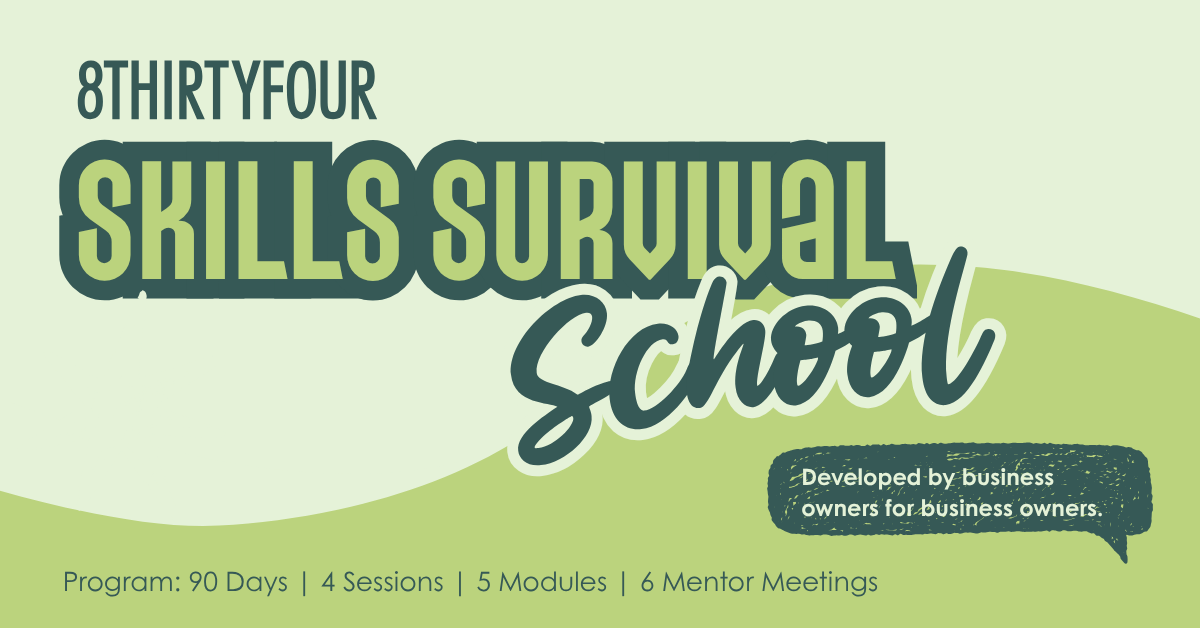

8THIRTYFOUR Skills Survival School
Fixing the gap between the degree and the job.
8THIRTYFOUR Skills Survival School is about just that… survival. Right now, employees aren’t lasting more than a year, and employers are struggling to survive the turnover. This is the fix.
It’s 90 days where employees will learn, practice, and understand workplace professionalism, written and verbal communication, active listening, critical thinking, problem-solving, conflict resolution, and why staying is the best career move they could make.
We take an integrated approach, because it has to be:
- An EQ assessment
- In-person sessions
- Peer-to-peer collaboration
- Scenario-based eLearning
- Structured mentorship
- Self-reflection
Every single thing an employee does or does not do has a direct impact on your company’s growth; when they cannot communicate, solve problems independently, or navigate basic workplace dynamics, it costs you a whole bunch of money.
Companies investing in skills development programs retain 58% more employees. Mentorship programs specifically increase retention by 38%. — World Economic Forum / LinkedIn Learning
Use our sweet calculator below to see how much turnover is costing you.

The Survival Skills
Our integrated 90-day program addresses the emotional alongside the professional through in-person sessions, peer-to-peer collaboration, eLearning, self-reflection and mentorship. The mentor is assigned from inside your company, cause having a personal guide is what makes this stick.
69% of employees are more likely to stay for three years if they experience strong onboarding and development. — SHRM
Module — Before You Walk In (Pre-Program)
Video + guided reflection | 10–15 min
Introduces the program framework and captures the employee’s starting perspective. This response is revisited in the final module as a measure of growth.
Session 1 — The Unwritten Rules
In-Person | Half-Day
Workplace professionalism and self-awareness. Employees examine unwritten workplace norms, review their EQ assessment results, and begin mapping roles, teams, and opportunities within their own organization.
Module 2 — Read the Room
Interactive scenarios | 15–20 min
Branching workplace scenarios that reinforce professionalism from Session 1. Every choice leads to a different outcome.
Mentor Meeting 1
One-on-One | Structured conversation guide
Kickoff and goal setting with the employee’s company mentor.
Session 2 — Say What You Mean
In-Person | Half-Day
Employees practice delivering messages in writing, face-to-face, and to leadership, then script and deliver a real career move conversation at their company before the next session.
Module 3 — The Hard Conversation
Branching scenarios | 15–20 min
Navigating difficult workplace conversations through branching scenarios. Bridges communication from Session 2 with conflict resolution in Session 3.
Mentor Meetings 2 & 3
One-on-One | Structured conversation guide
Working through real workplace situations with the employee’s mentor.
Session 3 — Fix It
In-Person | Half-Day
Problem-solving and conflict resolution. Teams work through a structured problem-solving framework and practice navigating disagreement. Each employee identifies a real problem at their company and takes a step toward addressing it.
Module 4 — Think It Through
Interactive problem-solving | 15–20 min
Problem-solving at higher complexity. Prepares employees for the capstone in Session 4.
Mentor Meeting 4
One-on-One | Structured conversation guide
Continued application of program skills to the employee’s real work.
Session 4 — Make Your Move
In-Person | Half-Day
Capstone. Teams present a recommendation for a complex scenario under pressure. Each employee presents their internal career development plan: what they discovered about their organization, the conversations they had, and their plan for continued growth.
Module 5 — 90 Days Later (Post-Program)
Reflection + self-assessment | 10–15 min
Revisits the pre-program baseline. Guides a structured self-assessment and prepares the employee’s development plan for their mentor and manager.
Mentor Meetings 5 & 6
One-on-One | Structured conversation guide
Final meetings refine the development plan and capstone presentation. The mentor relationship continues after the program ends.
The Integrated Approach
The workplace has changed, and we have to acknowledge and accept that the old way of doing things is just not how this generation operates. — Kim Bode
Skills Survival starts with an EQ assessment for both the employee and their manager.
Peer-to-Peer: Four half-day in-person sessions. employees work through realistic scenarios alongside peers from different companies, with direct feedback from the facilitator.
Scenario-Based eLearning: Five self-paced modules with interactive scenarios where employees make decisions and see consequences.
Internal Mentorship: Each employee is paired with a mentor* within their own company who meets with them 6 times during the program; this is how learning transfers into daily work.
Reflection: Built into every session and every module, employees continuously assess their own growth, from a pre-program baseline through a post-program self-assessment documenting what changed.
Comprehension: Completion is based on demonstrated ability. Modules include built-in assessments, sessions require participation, and the final session includes a capstone presentation.
Employer Dashboard: Managers can track employee progress, module completion, assessment scores, and mentor meeting milestones throughout the program. You see the results, not just a certificate at the end.
*Mentors are onboarded, provided with a guide and all mentoring is down through the 8THIRTYFOUR Schools eLearning Hub.
The average tenure for Gen Z employees in their first five years of work is 1.1 years. The primary driver of early departure is a perceived lack of development pathways, not compensation or disloyalty. — Randstad, 2025
It’s For Your People and Benefits You.
Workplaces with high employee engagement experience 24% lower turnover. Employees who feel supported by their manager are 63% less likely to actively look for a new job. — Gallup
Your employee walks out of this program understanding how they actually show up at work versus how they think they show up, and the impact it has. They learn that how they communicate, how they handle problems, and how they navigate disagreement directly impacts the team, the culture, and their own trajectory. And instead of building a case to leave, they build a plan to grow where they are — identifying roles, relationships, and opportunities inside your organization that they didn’t know existed, and having the conversations that turn those into real career moves.
Additional Program Information
Key Takeaways
- EQ assessment data for both participant and employer/manager, establishing a measurable baseline
- A completed internal career development plan, presented to their mentor and manager
- A trained internal mentor who continues the relationship after the program ends
- Employer dashboard with visibility into completion, scores, and milestones
- Pre- and post-program self-assessment documenting growth across all skill areas
- Program workbook with exercises, reflections, and Career Moves discovery work
- Access to the 8THIRTYFOUR Schools Hub, including cohort community and additional programs
- Certificate of completion
The Survivalists

Kim Bode is the founder and CEO of 8THIRTYFOUR, a communications and learning company, and the creator of lots of really good programs like the Women’s Entrepreneurial Fellowship, Big Deal Energy™, the QUIRKS™ personal branding framework, 8THIRTYFOUR Skills Survival School…oh she also speaks nationally on all of this. She has spent more than two decades working in communications, strategy, and leadership development, and she personally facilitates every session of 8THIRTYFOUR Skills Survival School with OSP (other smart people).
Kim built this program because it required a pretty different approach that addresses the mental and emotional, alongside the professional. You cannot separate how someone handles stress from how they handle a difficult client conversation. 8THIRTYFOUR Skills Survival School is focused on the practical, measurable, and designed for how people actually learn.
FAQs
How much time does this require from my employee?
The four in-person sessions are half-days, scheduled well in advance. Between sessions, employees spend approximately two to three hours per week on eLearning modules, mentor meetings, and application assignments. The between-session work is connected to the employee’s actual job, so it contributes to their performance rather than pulling them away from their regular responsibilities.
How is this different from a one-day workshop or online course?
A single training event does not produce lasting skill development. Skills Survival School runs for 90 days because that is the time required for new skills to become consistent behavior. The program combines four methods of learning — facilitated in-person sessions, interactive eLearning, structured mentorship, and real-world application — each one reinforces the others. Comprehension is assessed throughout, and completion is tracked consistently.
Will this program encourage my employees to look for jobs elsewhere?
The program is designed to produce the opposite outcome. The internal career development framework teaches employees to discover roles, projects, and growth opportunities within their current organization. Every between-session assignment is grounded in the employee’s own company. The mentor is someone from inside their own organization. Research from Randstad shows that the primary reason early-career employees leave is not disloyalty or compensation; it is a perceived lack of development pathways in their current role. This program creates those pathways.
What visibility do I have into my employee’s progress?
The employer dashboard provides visibility into module completion, assessment scores, and program milestones. The EQ assessment includes an employer or manager version administered before the program. In the final session, each employee presents their internal development plan, which they can share with their manager.
How are mentors selected and trained?
Mentors are selected from within the employee’s own organization. We work with you to identify the right person. The mentor does not need to be in a senior leadership role or have prior mentoring experience. All mentors complete an onboarding module and receive structured conversation guides and check-in templates for each meeting.
What if I want to enroll more than one employee?
Group pricing is available for groups of 3 or more employees, employees are enrolled in different cohorts to ensure comprehension. Enrolling multiple employees from the same company can increase impact because employees develop a shared language around communication, problem-solving, and professional expectations that they bring back to the workplace together.
What is the founding cohort?
This is the first group to complete the program. Participants receive the full 90-day experience at $2,000 per person, half the standard $4,000 price. In exchange, founding employees and businesses provide structured feedback, testimonials, photos, video, and interview participation, which are then used to improve the program and market future cohorts. Limited to 8 employees.
What happens after the program ends?
Participants retain access to eLearning modules and the cohort community. Assessment data is available for the employee and their manager. The internal mentor relationship continues. Six months after the program, each employee receives a sealed letter they wrote to themselves during the final session.
There is nothing soft about the cost to your business.
Replacing an employee costs 50–200% of their annual salary. For a position paying $50,000, that is $25,000 to $100,000 in recruiting, onboarding, and lost productivity. — Gallup / SHRM
What Does Turnover Really Cost You?
Adjust the numbers below — we'll show you what replacing one employee actually runs, and how it stacks up against investing in the one you already have.
About the Role
Recruiting & Interviewing
Onboarding & Ramp-Up
Your Results Are Ready
Enter your email below to unlock your full turnover cost breakdown — and see how much you could save.
Your Cost Breakdown
Investing in your current employee saves you $0 — and keeps your team intact.
8THIRTYFOUR Skills Survival School is about just that… survival. Right now, employees aren't lasting more than a year, and employers are struggling to survive the turnover. This is our fix.
It's 90 days where employees will learn, practice, and understand workplace professionalism, written and verbal communication, active listening, critical thinking, problem-solving, conflict resolution, and why staying is the best career move they could make.
We take an integrated approach, because it has to be:
- An EQ assessment
- In-person sessions
- Peer-to-peer collaboration
- Scenario-based eLearning
- Structured mentorship
- Self-reflection
↓ Download my report