What is a SWOT Analysis?
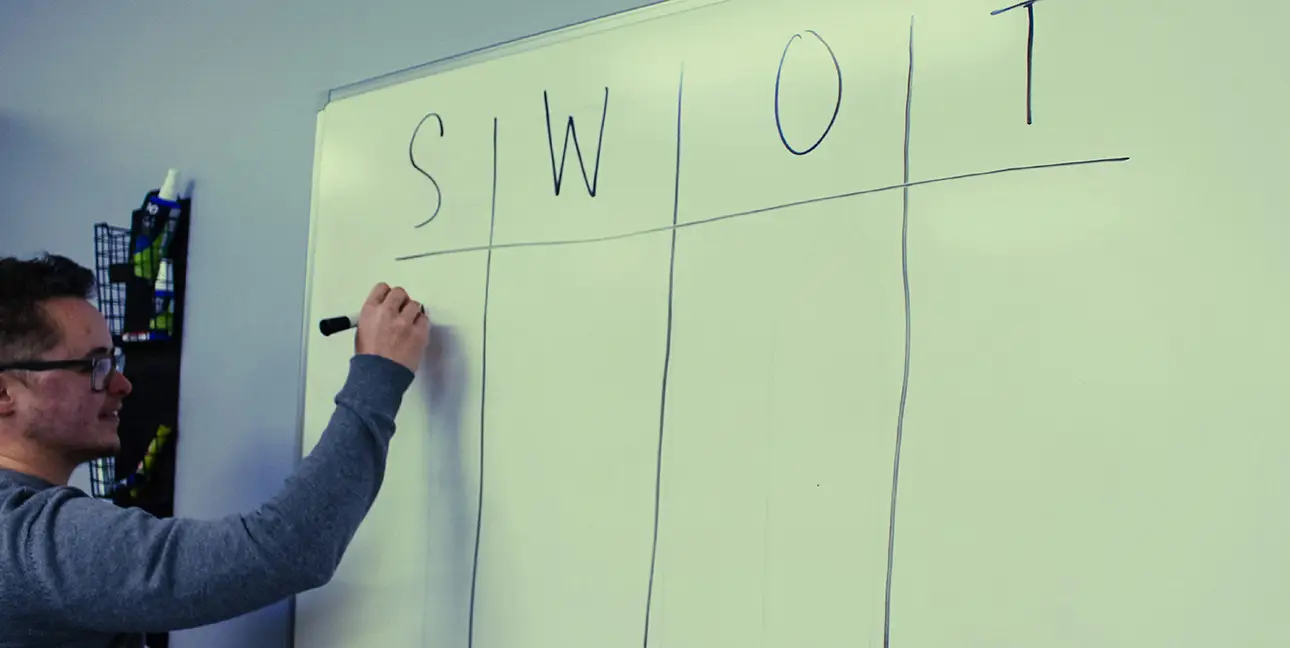
A SWOT analysis is an overview of a business’s strengths, weaknesses, opportunities, and threats. This ensures that leadership is on the same page regarding the company’s position in the marketplace, and helps to identify strategic opportunities for a brand.
Strengths and weaknesses are internal to the company (think: quality, proprietary systems, team members). You have the control and can change these items over time.
Opportunities and threats are external to the company (think: political and social factors, competitors, supply chains)—they are out there in the market, happening whether you like it or not. You do not have the power to change them.
When to Use a SWOT Analysis
The SWOT analysis is one of our favorite components of any marketing strategy. This can be used at any time to assess a constantly changing environment, and respond proactively where needed. We recommend conducting a full strategy review at least once a year.
New businesses should also use a SWOT analysis as a part of their planning process to get them off on the right foot.
How to Do a SWOT Analysis
The SWOT analysis involves 4 key components, followed by strategic evaluation afterwards. Follow this formula and you’ll be SWOTing away in no time!
1. Strengths
Strengths are usually the easiest part of this activity. These should be considered from both an internal perspective, and from the point of view of your audiences. Remember, these are aspects of the company, and the organization has the power to change them over time.
Strengths include:
- Things the company does well
- Qualities that separate the company from competition
- Internal resources, such as skilled staff
- Tangible assets such as intellectual property, capital, proprietary technologies, etc.
If a factor is a requirement of the industry, this does not count as a strength. For example, if all your competitors provide high quality products, then high quality products are not really a strength to you. They are more of a necessity.
Factors to consider include: financial strengths, customer strengths, internal strengths, etc.
The following questions will help you identify strengths:
- What advantages does your organization have?
- What is your most reliable source of growth?
- What do you do better than anyone else?
- What unique or lowest-cost resources can you draw upon that others can’t?
- What do people in your market see as your strengths?
- What factors help you close a sale or a deal?
- What is your organization’s USP?
2. Weaknesses
Weaknesses should also be considered from both an internal perspective, and from the point-of-view of your audiences. Again, these are aspects that are internal to the company, and the organization has the power to change them over time.
Weaknesses include:
- Things the company lacks
- Things that competitors do better
- Unclear unique selling proposition
Factors to consider include: financial weaknesses, customer weaknesses, internal weaknesses, and learning or growth weaknesses.
The following questions will help you identify weaknesses:
- What could you improve?
- What do your customers think you need to improve?
- What are you biggest challenges with employees?
- What should you add?
- What should you avoid?
- What are people in your market likely to see as a weakness?
- What factors lose you sales?
- Why do people leave?
3. Opportunities & 4. Threats
Opportunities and threats represent external factors that are either favorable or unfavorable for the organization. These should also be considered from an internal and external perspective, but these factors are outside of the company’s control.
Opportunities may include
- Underserved markets for specific products
- Lack of competition
- Emerging need for your product or service
Threats may include:
- Emerging competitors
- Changing regulatory environment
- Changing consumer trends
The following factors should be discussed and researched to identify opportunities and threats:
- Economy
- Politics
- Public policy & regulations
- Technology
- Social values & trends
- Labor force
- Competitors & 3rd parties
- Supply chains
- Events
What It All Means
Once you have your SWOT items identified, how do you put this to use? What do you do with this information?
The SWOT analysis is intended to give leadership a clear, objective picture of an organization’s position in the market. This information should also be used to inform strategic direction for a business.
Below are some examples of strategic impact, gleaned from items identified during the SWOT analysis.
1. Leveraging Strengths
Do strengths open any opportunities on their own?
Ex: Great storefront location (S) → leverage with an eye-catching window display
2. Strength-Opportunity Strategies
Which of the company’s strengths can be leveraged to maximize the opportunities that were identified?
Ex: Satisfied restaurant customers (S) + Yelp just launched (O) → referral reward program to incentivize referrals and reviews
3. Strength-Threat Strategies
How can the company’s strengths be used to minimize the threats identified?
Ex: Supply chain limitations (T) + production capacity (S) → leverage production capacity to produce in house or increase on-hand inventory levels
Ex: Supply chain limitations (T) + financial capital (S) → leverage financial capital to budget significantly for unplanned spend
5. Converting Weaknesses
Can any of the weaknesses be overcome, and turned into marketing opportunities?
Ex: Lack of social following (W) → leverage social advertising to build audiences
Ex: High turnover rates (W) → Improve internal recruitment processes, leverage marketing channels to promote team members, develop ambassador program to engage staff
6. Weakness-Opportunity Strategies
What actions can be taken to minimize weaknesses, using or taking advantage of the opportunities identified?
Ex: Small marketing budget (W) + 3D printing technology (O) → Increase budget, hire 8THIRTYFOUR to establish you as a prominent player in the 3D printing space and capitalize on highly profitable market opportunities
Ex: High turnover rate (W) + social trends shifting in favor of working remotely (O) → offer employees the ability to work remotely every Friday
7. Weakness-Threats Strategies
How can you minimize the company’s weaknesses to avoid the threats identified?
Ex: Lack of capital (W) + political policies negatively impacting funding (T) → develop and execute a capital campaign
Ex: Low customer retention rate (W) + increased prevalence of user reviews and referrals online (T) → reevaluate customer service processes, develop customer rewards program
Need Some Help with Your SWOT?
If your team is finding themselves overwhelmed, or not knowing where to start, our strategy pros are here to help. Contact us for more information!