Unless you live your life under a very large boulder (possibly a mountain), you have inevitably heard something about Pokémon GO, the viral mobile game that was released in the U.S. about a week ago. The hype for the augmented-reality game was enormous as soon as Nintendo announced its production. Now that it has been released, the app has garnered 7.5 million U.S. downloads on iOS and Android devices and is earning a daily revenue of $1.6 Million on the Apple iOS store alone. This revenue has resulted in Nintendo stock skyrocketing to about $9 billion in one week. But that’s not all there is to know about the Pokemon GO marketing tornado. We’ll break it down for you:
What is Pokémon Go?
We will try to keep this short and sweet, but there is a lot to cover. Pokémon GO is a free mobile app that uses GPS to pinpoint the player’s location. The game creates an overlay for the real world and places a customizable avatar in an augmented-reality (AR). In the AR, there are gyms to battle at and take control of, Pokéstops to collect items from and obviously, tons of Pokémon to catch. The real draw of the game is that you have to travel around in the real world to find elements in the AR. Gyms are found in multiple places such as churches, breweries, restaurants and historic landmarks. The PokéStops are similar, but are more often found at local art pieces and well-known landmarks. Additionally, Pokémon can be found in different places depending on their type (i.e. water type Pokémon are found near water, grass type in open fields, etc.). The idea of the game is to catch all the Pokémon by exploring the world and gaining experience by battling at gyms. There are many more pieces to the game such as teams and special items. For those interested, read more here.
So, what makes Pokémon GO so successful?
As a team of marketing nerds, we were intrigued by what has made this game so great. So, as we do, we came up with a list. Here is why Pokémon GO is killing it!
The Nostalgia Factor:
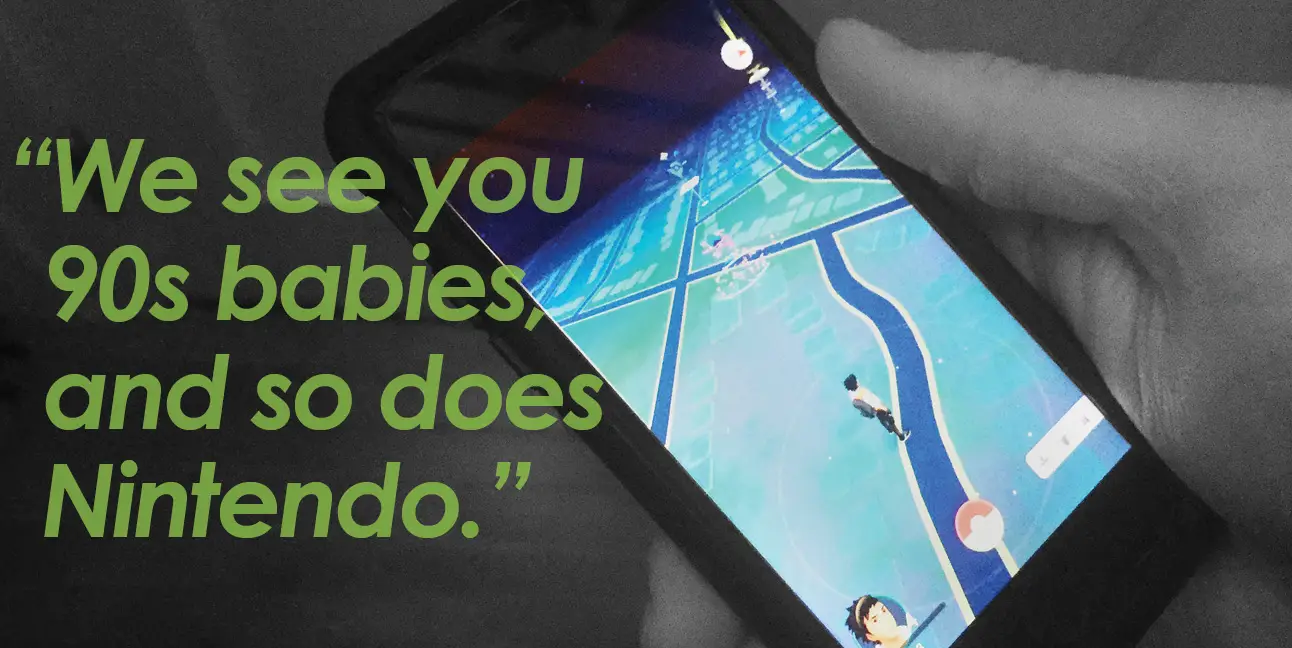
We see you ’90s babies, and so does Nintendo. The gaming Goliath has always held the Pokémon franchise close. While Nintendo has continually developed new games for the Pokéverse and expanded the number of creatures to catch, they have only done so on limited handheld gaming platforms. Even with that limited access, the franchise has remained popular since its release in the late ’90s, but mostly among a younger audience. Pokémon GO has brought back all of the nostalgic feels by dropping people who grew up with the game into the universe they love.
The sentimental feelings for the franchise have helped the company deal with a rough launch that included multiple bugs, continuous server connectivity issues and odd/negative press stories. This goes to show what a strong relationship from consumer to company can do.
Rewards:
A huge component of Pokémon GO is the excitement of finding a new or rare Pokémon. In addition to that excitement, the game gives you extra perks for catching them. Marketers should take note of how consumers are more likely to engage with those brands that actively engage back and reward loyal users. While this particular scenario involves a game, there are plenty of options out there for strategic marketing to reward consumers and keep the engagement up.
Listening to Your Audience:
There has been a big push on Nintendo from its fans in recent years to begin developing mobile games. For a while, the company fully rejected the idea of bringing any of its properties to smartphones or tablets, but with time, Nintendo saw that it could be a good opportunity. Obviously, Nintendo executives caved and it ended up working out great for them. Giving your customers what they ask for and making changes in their interest are great ways to maintain a relationship and show that the company is listening to the requests made by customers. This helps them feel like their voice makes a difference.
Accessibility:
We briefly mentioned this above, but accessibility has played a huge role in the success of Pokémon GO. It seems as though almost everyone has a smart phone, the app is free to download and it can literally be played everywhere players have a data connection. Providing consumers with that type of accessibility allows them to use it at their convince resulting in more overall use. Additionally, players don’t have the stigma of carrying around a Gameboy or Nintendo DS to play Pokémon anymore, which can be seen as childish. Instead, they are able to use their phone, which is more “socially acceptable.”
Viral phenomenon like Pokémon GO can teach us a lot about what works in a marketing. While some may be flops, they are worth looking into to find out more of how consumer relations and marketing strategy can be edited to make your campaign more successful.
Let us know if you have anything we could add to our list and what team you’re on if you’re playing.
Happy Pokémon hunting!